
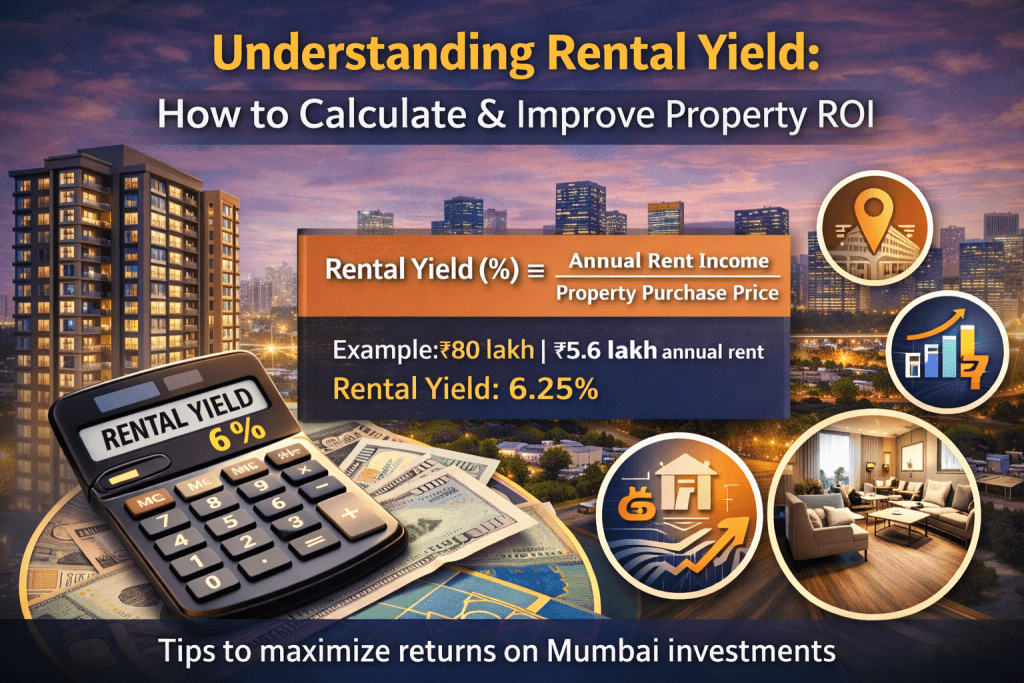
Understanding Rental Yield: How to Calculate and Improve Your Returns on Investment Properties
Investing in property in Mumbai can provide both capital appreciation and rental income. To evaluate investment efficiency, it’s important to understand rental yield, which measures the annual rental return relative to the property cost. Knowing how to calculate and improve rental yield helps investors maximise profits and make informed decisions.
What is Rental Yield?
Rental yield represents the return earned from a property in the form of rent, expressed as a percentage of its total cost.
- Formula: Rental Yield (%)=Annual Rent IncomeProperty Purchase Price×100\text{Rental Yield (\%)} = \frac{\text{Annual Rent Income}}{\text{Property Purchase Price}} \times 100Rental Yield (%)=Property Purchase PriceAnnual Rent Income×100
- Example: If a flat costing ₹1 crore earns ₹6 lakh annually in rent, the yield is:
6,00,0001,00,00,000×100=6%\frac{6,00,000}{1,00,00,000} \times 100 = 6\%1,00,00,0006,00,000×100=6%
It’s a quick way to assess investment profitability independent of market appreciation.
Factors Affecting Rental Yield
Several factors influence rental yield in Mumbai:
- Property Type and Size: Smaller units often have higher rental yields compared to larger ones.
- Location: Proximity to business hubs, schools, and transport increases rental demand.
- Amenities: Gated communities, security, gyms, and parks attract tenants willing to pay higher rent.
- Market Conditions: Economic growth, supply-demand balance, and infrastructure development affect rents.
- Maintenance and Management: Well-maintained properties command better rent and retain value.
How to Improve Rental Yield
Investors can enhance yield by following these strategies:
- Choose High-Demand Locations: Areas near metros, IT hubs, and educational institutions ensure stable occupancy.
- Focus on Smaller Units: 1 BHK and 2 BHK units often offer higher yields due to affordability and strong rental demand.
- Upgrade Interiors and Amenities: Modern kitchens, wardrobes, and efficient lighting attract premium tenants.
- Regular Maintenance: Keep the property in excellent condition to justify higher rent and reduce vacancy periods.
- Flexible Lease Terms: Offering short-term or furnished rentals can increase income, especially for corporate tenants.
A proactive approach ensures maximum rental returns over time.
Evaluating Long-Term ROI
Rental yield is only part of the equation:
- Capital Appreciation: Property in growth corridors may gain value over time.
- Expenses Deduction: Account for maintenance, property tax, and management costs when calculating net yield.
- Loan Repayment Impact: If financed via a home loan, EMIs reduce actual cash flow from rent.
Balancing rental income with expenses ensures realistic and sustainable returns.
Practical Example
- Property Price: ₹80 lakh
- Annual Rent: ₹5.6 lakh
- Maintenance/Other Expenses: ₹0.6 lakh
Net Rental Yield:
5.6−0.680×100=6.25%\frac{5.6 – 0.6}{80} \times 100 = 6.25\%805.6−0.6×100=6.25%
This simple calculation helps compare properties and make investment decisions.
Conclusion
Understanding and improving rental yield is crucial for real estate investors in Mumbai. By choosing prime locations, optimizing property size, maintaining quality, and offering tenant-friendly features, investors can maximize rental returns.
A well-planned approach to rental yield not only ensures steady cash flow but also enhances the long-term value of the investment property.